ThermInfra’s Perspective on High-Density AI Cooling
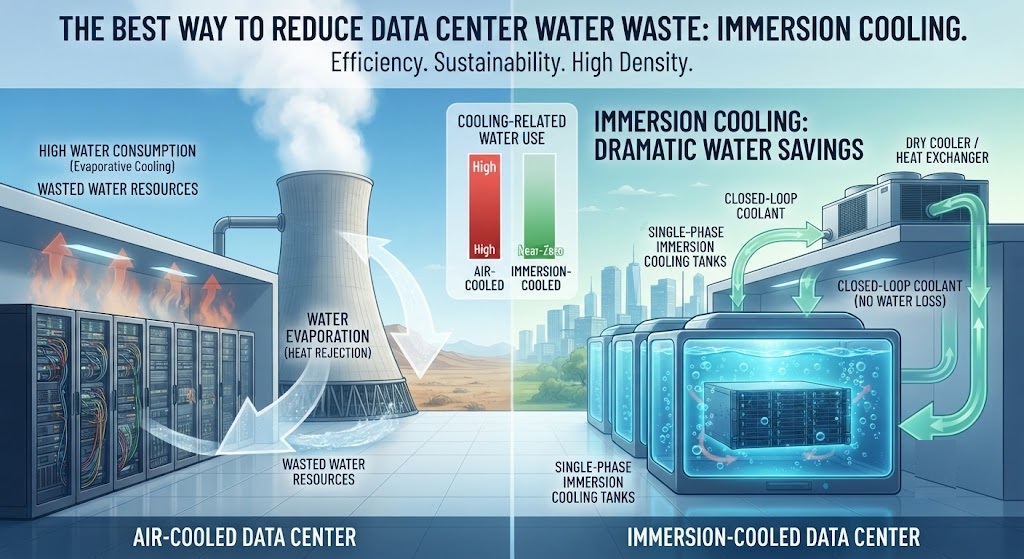
AI workloads are driving data center rack densities from tens of kilowatts to megawatt-scale systems, creating a major infrastructure challenge: how to remove massive amounts of heat without draining public water systems. While traditional evaporative cooling offers high energy efficiency, it continuously evaporates water, posing severe constraints in water-stressed regions and complicating site permitting and long-term expansion.
To solve this, modern cooling architecture must decouple heat removal from water consumption using advanced, closed-loop systems. Air cooling remains mature and effective for low densities, but struggles with the sheer thermal output of modern AI accelerators, while direct-to-chip liquid cooling successfully targets high-power processors using closed-loop cold plates.
Immersion cooling takes this evolution a step further by submerging entire servers in engineered dielectric coolants. Single-phase immersion surrounds the IT equipment in a recirculating fluid that transfers heat cleanly to a dry cooler or water loop, achieving high density, improved acoustic performance, and near-zero operational water consumption. Meanwhile, two-phase immersion leverages a controlled boiling and condensing phase-change cycle to deliver exceptional thermal performance for extreme heat-flux applications.
Ultimately, the future of sustainable data center infrastructure relies on matching the right thermal architecture to each specific deployment. By integrating single-phase or two-phase immersion cooling with efficient heat-rejection strategies, operators can successfully balance energy efficiency, spatial density, and strict water conservation.
Beyond managing water constraints, single-phase and two-phase immersion technologies fundamentally transform the physical and economic architecture of modern data centers. By eliminating the need for massive airflow infrastructure, high-speed server fans, raised floors, and complex air containment systems, facility operators can significantly reduce capital expenditures and save valuable floor space. This simplified mechanical layout also lowers parasitic power loads associated with air-handling units, directly improving the overall Power Usage Effectiveness (PUE) of the facility.
Furthermore, these advanced cooling methods unlock new pathways for environmental sustainability through energy reuse. Because dielectric coolants capture heat at relatively high and stable temperatures, operators can redirect thermal waste toward district heating networks, agricultural applications, or industrial processes rather than simply rejecting it into the atmosphere. This capability turns data centers from energy-intensive burdens into active participants in local circular economies, proving that the next generation of AI infrastructure can achieve high-density performance while operating sustainably.